If you've ever delayed buying a product because you hoped the price would drop, you're not alone. Millions of online shoppers spend time refreshing product pages, comparing options across stores, and wondering if today's deal is actually the best they'll get.
This raises an important question:
Is manual price checking still worth your time, or is automated price tracking the smarter approach?
We've been knee-deep in e-commerce pricing for years now—building these tools, studying how prices shift, and basically obsessing over why that same product costs different amounts at different times. And here's the thing: retailers are changing them constantly. Multiple times a day, sometimes. They're constantly tweaking things based on what's selling, what's in stock, what competitors are charging, and whatever promotional events are happening that week.
In this guide, we're gonna break down price tracking vs manual price checking—basically, the two main ways people hunt for deals. We'll walk you through what each method actually does, show you the real pros and cons of both, and then help you figure out which one's actually gonna save you the most money.
What Is Manual Price Checking?
It's pretty much what it sounds like—you're constantly jumping onto Amazon or whatever retailer, hunting for the product, and seeing if the price has dropped since last time you checked.
Here's how it usually goes:
Open Amazon or your favorite retailer
Search for the product you want
Check today's price
Try to remember what it cost yesterday (good luck with that)
Come back tomorrow and do it all over again
Some people get really into it:
Keep spreadsheets tracking everything
Screenshot listings to build a price history
Bookmark tons of product pages
Compare product prices across multiple stores manually
Honestly? It works fine if you're only watching one or two products. But the second you're monitoring a handful of items? It gets messy fast. Like, really messy.
What Is Price Tracking?
Price tracking is basically the lazy person's dream—it does all the work for you.
Instead of spending your evenings refreshing product pages like some kind of deal-hunting robot, a price monitoring tool just... watches everything for you. It's constantly watching in the background, and whenever something actually matters (like a price drop), it sends you a notification.
Here's what modern tools can actually do:
Monitor products 24/7 so you never miss a change
Record price history so you can see the real trends (not just today's price)
Automatically spot discounts as they happen
Send you price drop alerts the second things go on sale
Compare product prices across different retailers automatically
Catch those "fake discounts" where retailers pretend something's on sale when it's not
Pretty much—instead of you checking, the software does it. You just sit back and wait for the alerts. Game changer, honestly.
Side-by-Side Comparison
Feature
Manual Price Checking
Price Tracking
Time Required
High
Very Low
Tracks Multiple Products
Difficult
Easy
Price History
Usually unavailable
Available
Automatic Alerts
No
Yes
Detects Small Changes
Often missed
Yes
Works While You're Busy
No
Yes
Helps Avoid Fake Discounts
Limited
Much better
For most shoppers, automated tracking offers significant advantages over checking by hand.
The Biggest Problems With Manual Price Checking
1. It Takes Too Much Time
Here's where it gets real. Imagine you're tracking just ten products. If each one takes a minute to check—just one minute—you're already burning ten minutes a day. Every. Single. Day.
Let that sink in for a month:
300+ minutes of your life
Nearly 5 hours spent refreshing pages and comparing options
That's literally five hours a month you could be doing literally anything else. Working, scrolling TikTok, sleeping, actually enjoying your online shopping instead of stressing about it. You could be out finding actual shopping deals instead of becoming a price-checking machine.
And that's just ten products. Most people tracking more than that? They're losing way more time.
2. You Might Miss the Best Price
Some discounts last only a few hours.
If you check:
every evening
every weekend
once a week
there's a good chance you'll miss short-lived promotions.
Automated monitoring catches these opportunities much more reliably.
3. Human Memory Isn't Perfect
Here's the catch though—a lot of discounts? They're gone in like a few hours. Seriously.
So if you're only checking:
Every evening after work
On weekends when you remember
Once a week if you're feeling lazy
...there's a solid chance you're gonna miss the good stuff. Those flash sales and limited-time shopping deals? They're already over before you even knew they existed.
That's where automated monitoring totally changes the game. A price tracker doesn't sleep. It's watching 24/7 and catching those quick price drop alerts the second they happen. You're not relying on luck or your memory anymore—the software's got your back and notifies you before the deal disappears. It's like having someone whose entire job is hunting for discounts for you, except it costs way less and actually works.
4. Comparing Multiple Stores Is Exhausting
And here's another thing—most products aren't just on Amazon. They're everywhere.
You'd need to check:
Amazon
Walmart
Best Buy
Target
Like a dozen other marketplaces
...every single day. And yeah, that gets old fast. You're basically doing the same thing over and over, jumping from store to store, trying to compare product prices and figure out who's actually got the best deal. It's repetitive, it's exhausting, and honestly? You'll probably miss something.
Why Price Tracking Is Becoming More Popular
Here's the thing—online prices are basically moving targets. They're changing all the time.
Retailers aren't just sitting with one price. They use fancy dynamic pricing systems that constantly adjust based on stuff like:
How many people want it (demand)
What competitors are charging
How much inventory they've got left
Seasonal stuff (holidays, back-to-school, etc.)
Flash promotions that pop up out of nowhere
There's no way to keep up with all that manually. That's why more and more shoppers are ditching the constant refreshing and turning to automated tools instead. The software just... handles it all for you.
And honestly? This becomes crucial during the big events:
Black Friday madness
Prime Day deals
Holiday sales when everything's marked down
Back-to-school promotions
These are literally when those alerts matter most. Prices are moving fast, deals are disappearing in minutes, and you need something that's actually paying attention. Automated monitoring isn't just convenient during normal shopping—it's the difference between catching those shopping deals and completely missing them.
Want to dig deeper? Our guide on how to spot fake discounts walks you through 8 easy ways to tell a real deal from a fake sale.
Benefits of Using a Price Tracker
Never Miss a Price Drop
Honestly? The biggest benefit is just that it's automatic.
You set up tracking for something you want, pick your target, and then... you just forget about it. Seriously. The tool handles everything. The second it drops to your target, you get a notification. Boom. Done.
No more refreshing product pages obsessively. No more "let me check again tomorrow" routine. No more wondering if you're missing deals while you sleep or work or actually live your life.
You set it and forget it. That's the whole point. And when a price drop alert hits your phone? You know it's actually worth paying attention to—because that's the price you wanted. No guessing, no second-guessing. Just catch the deal and move on.
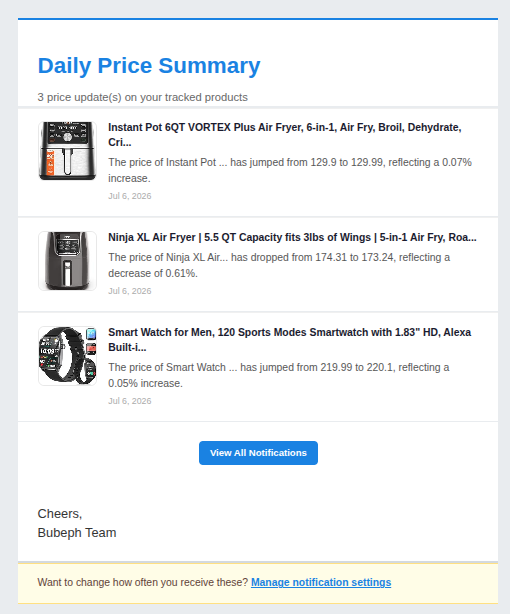
Here's one that popped up on my phone the other day—a quick heads-up letting me know something on my list had finally dropped:
A price-drop alert from Bubeph landing in my inbox — the instant a tracked item hit the price I'd been waiting for, no manual checking required.
View Complete Price History
One of the best features? Price history. Hands down.
Here's the problem—when you see a "sale," your brain immediately wants to believe it. But is it really a discount? Or is the retailer just jacking up the price and calling it a sale? Yeah, that happens.
With a tracker, you can actually see:
What the price was last month
The highest it's ever been
The lowest it's ever been
What it normally costs on average
So instead of just trusting whatever number's on the screen today, you've got real data. You can actually tell if today's "promotion" is legitimately a good deal or if it's one of those fake discounts retailers use to mess with you. It's like having X-ray vision for prices.
That's how you save money online for real—you're not falling for marketing tricks. You know exactly whether something's actually worth buying right now or if you should wait for a better deal.
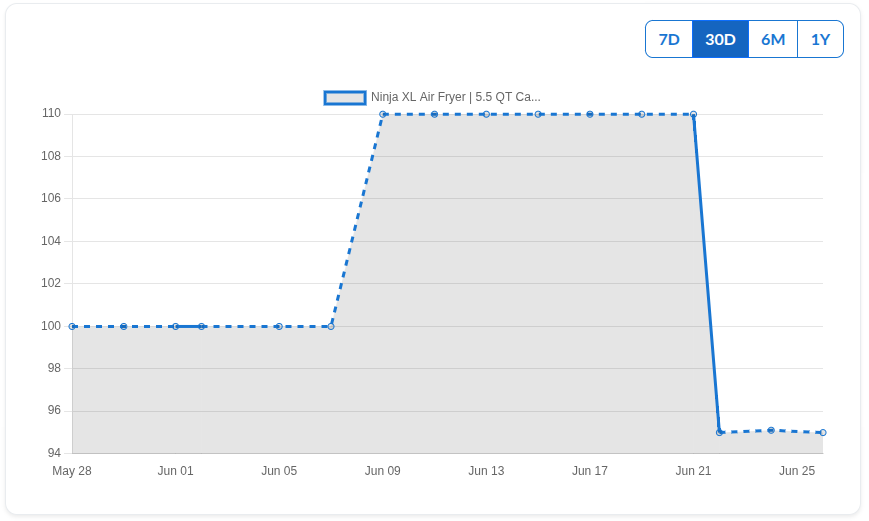
Take a real example—the Ninja XL Air Fryer (model AF150AMZ). Pull up its price history on Bubeph and the story tells itself: the “sale” price is the same figure it's been hovering around for weeks. What looks like a markdown is really just the everyday price wearing a discount sticker.
The Ninja XL Air Fryer's price history on Bubeph: the “sale” price simply matches what it had cost all along — a clear sign the discount isn't real.
Save Time
Automation means you're not checking dozens of products manually every day anymore. Just set it up, wait for the price drop alert, and go live your life. No refreshing pages, no constant monitoring—the tool does the boring stuff so you don't have to.
When Manual Price Checking Actually Makes Sense
Look, manual price checking isn't always the wrong move.
If you're just:
Buying something cheap and you need it now
Comparing products once and calling it a day
Barely shopping online anyway
Only watching one product
...then honestly? Checking manually is fine. No need to overthink it.
For those occasional one-off purchases, checking by hand is totally reasonable. You don't need automated tracking for everything. Just depends on how serious you are about saving money online.
When Price Tracking Is the Better Choice
Now, automated tracking really shines when:
You're waiting for that sale to actually happen
You're eyeing some expensive electronics and don't want to overpay
You're furnishing your whole apartment or house (those costs add up fast)
You're shopping during the big seasonal events—Black Friday, Prime Day, holidays
You've got a whole wish list of stuff you're keeping tabs on
You literally just want to save money online without spending hours hunting for deals
Here's the thing—the more products you're monitoring, the more automation actually pays off. Like, if you're tracking just one thing? Maybe manual checking works. But if you've got ten, twenty, fifty things you're watching? That's when a tracker becomes genuinely worth it.
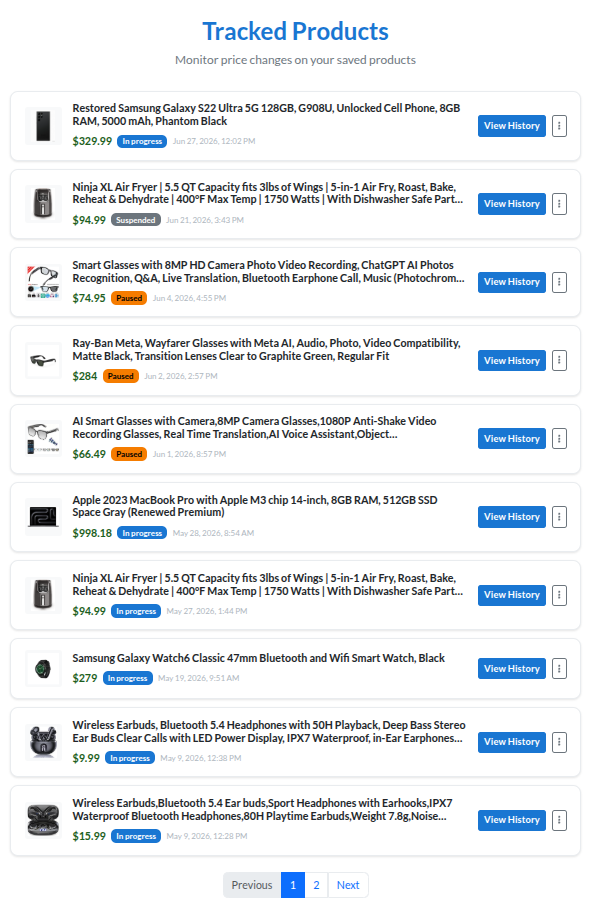
Here's a peek at my own watchlist — a mix of gadgets, home gear, and a few things I'm in no rush to buy, all sitting on Bubeph and quietly tracked around the clock. (My friend's list is honestly even longer than mine.)
My Bubeph watchlist — everything I'm keeping an eye on in one place, monitored 24/7 so I never have to check each item by hand.
How Bubeph Makes Price Tracking Easy
Instead of manually visiting product pages every day, Bubeph automates the process.
With Bubeph, you can:
Track products from supported online stores.
Receive price drop alerts when prices change.
View historical price charts before buying.
Analyze products to make more informed purchasing decisions.
Monitor multiple products simultaneously.
Whether you're shopping for electronics, household items, or everyday essentials, automation helps remove the guesswork from finding the best time to buy.
Frequently Asked Questions
Is price tracking better than manual price checking?
For most people? Yeah, honestly. It saves you time, gives you actual price-history data instead of just guessing, and hits you with a price drop alert the second something drops. It basically removes the guesswork from knowing when to actually buy something.
Can price trackers detect fake discounts?
A lot of them can, actually. Since these tools show you past prices, you can literally see if a retailer jacked up the cost right before slapping a "50% off" sticker on it. Spoiler alert: they do that. A lot. So yeah, you can spot those scams pretty easily when you've got the actual data.
Do online prices really change that often?
All. The. Time. Retailers are constantly tweaking them based on how much people want something, what competitors are doing, inventory levels, and whatever promotions are happening that week. It's basically impossible to keep up with manually.
Is manual price checking still useful?
Sure, but like... only for certain things. If you're buying something cheap and you need it right now? Fine, check manually. But if you're monitoring multiple products or actually waiting for a solid deal? Automation just works better. No contest.
Conclusion
Manual price checking works for occasional purchases but takes time, requires consistency, and relies on luck. Price tracking is more reliable—it monitors 24/7, shows price history, and sends price drop alerts automatically.
If you shop online regularly or wait for discounts on expensive items, a price tracker like Bubeph saves you time and helps you buy with confidence.
Price Tracking vs Manual Price Checking: Which Saves You More Money?