It is no longer up to chance or speculation to determine the best time to buy online.
In order to make data-driven purchasing decisions, astute consumers now rely on tools
like Bubeph to examine price history and receive price drop alerts.
You'll learn how price trends operate, how to identify real deals, and how to use them
to efficiently track products in this guide.
What Is Price History and Why It’s Important
Price history demonstrates how a product’s cost changes over time.
Rather than relying only on the current price, you can:
- Identify the lowest and highest price points
- Spot recurring price drops
- Verify whether discounts are genuine
- Predict the best moments to buy
Instead of making purchases based on hype, historical pricing data enables
well-informed decisions.
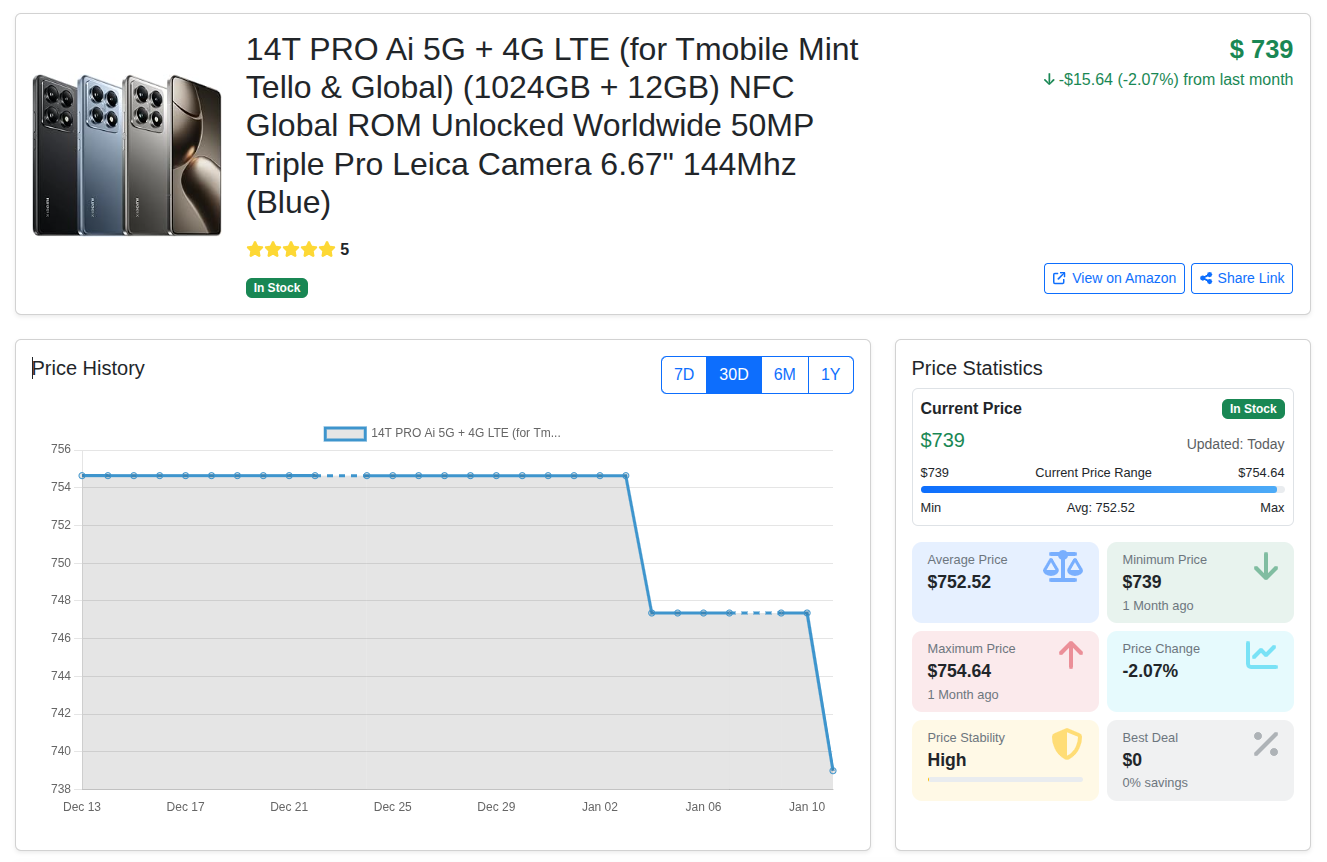
Here is an example of the product 14T PRO Ai 5G + 4G LTE with its price
history, showing different changes over time.
How Price History Helps You Choose the Right Time to Buy
By analyzing price history, you can answer questions like:
- Is the product currently overpriced?
- Does the price usually fall after major sales?
- How often does it reach its lowest point?
- Are current discounts meaningful?
This approach replaces impulse buying with logical, data-backed decisions.
How a Smart Shopper Saved $120 Using Bubeph
Suppose Sarah wants to buy a new wireless headset. She finds a deal online but isn’t
sure it’s the best price.
How Sarah Uses Bubeph
-
Check Price History:
Sarah notices the price drops every two to three weeks and that the current sale is
still $30 above the historical low.
-
Set a Price Drop Alert:
She sets a target alert at $150.
-
Wait for Notification:
Three days later, Bubeph notifies her of a drop to $149.
She purchases immediately and saves $120.
🔗 Related read:
how to save money with price tracking bubeph
Best Time to Buy Online (Based on Data)
1. After Major Sales Events
- Pre-sale prices may be inflated
- Unsold stock often gets discounted
- Historical trends show post-sale drops
2. When New Models Are Released
Older models drop when new versions arrive, especially:
- Smartphones
- Laptops
- TVs
- Wearables
3. Midweek Shopping Patterns
Tuesday through Wednesday often show lower prices due to reduced shopping traffic.
4. Buying Products Off-Season
| Product |
Best Time to Buy |
| Air conditioners |
Fall / Winter |
| Heaters |
Spring / Summer |
| Travel gear |
After holidays |
| Electronics |
1–2 months after launch |
FAQs – Best Time to Buy Online
Q: What is the best time to buy online?
A: When price history shows prices are below average, often midweek or after sales.
Q: Are price drop alerts reliable?
A: Yes. Alerts are triggered by real price changes and historical trends.
Q: Is price history better than discounts?
A: Absolutely. Price history reveals whether a deal is real.